Showing posts with label decay. Show all posts

6.01.2009

Steele's China

Steele's China Shop, located on the corner of Collier and Bayfield streets, was built in 1884 as a carriage shop. It is now behind scaffolding; the city issued a demolition permit two weeks ago and chances may be slim to have this building designated as historically significant by Heritage Barrie.


Steele's China Shop, located on the corner of Collier and Bayfield streets dates back to 1873 when two Barrie residents, James Barr and William Henry, started a company making wooden parts for carriages. By 1881 they had built a two-storey blacksmith shop on Bayfield Street, and just two years later began construction of a three-storey commercial building on the corner of Bayfield and Collier streets.


When completed in 1884, this polychromatic brick building precisely fit the unusually angled corner and was equipped with the most modern carriage-making technology of the time. Its first floor was a showroom and had an office, while the second was where painting and varnishing took place. This was reached by a special elevator that was large enough to hold a wagon or carriage. The third floor contained the trim shop and storage. It was accessible from the second floor of the blacksmith shop built behind 2 Collier St.


Harris Steele, a long-time downtown Barrie businessman, died in December of 2007 at age 76. He was the owner of Steele’s China and Gift Shop, after coming to Barrie in the late 1940s from Newfoundland. His parents, Samuel and Sybil Steele, set up the fine china shop at 2 Collier St., and Harris got into the business right out of Barrie Central Collegiate. Besides his passion for fine china, Steele was a sailor, very involved in the Barrie Yacht Club, the Grey and Simcoe Foresters and with the Rotary Club of Barrie. Steele had a quadruple bypass in early December of 2007 and was on the road to recovery, before suffering a massive stroke in his sleep on Dec. 14. He died two days later in Orillia’s Soldiers’ Memorial Hospital, surrounded by family and friends.


8.12.2007

Cheltenham Brickworks

This visit was a side-trip of the Mill Madness tour (to be posted latter). Participants (shown to the right) were neX, JuicyFriotKisses, and yours truly, CopySix.


Here's a short video starring the aforementioned explorers.


The Cheltenham Brickworks is just one of those obligatory locations where UrbEx folk must visit in order to boast a complete exploration portfolio. The site is fairly interesting but unless you are a local, one trip is considered sufficient.


The location is approximately a mile west from 'downtown' Cheltenham and is bounded by Mississauga Road directly adjacent to the east, the Bruce Trail on the south and the Brampton Brick quarry and yards to the north and west. The site is completely fenced but industrious youth have made this barrier somewhat porous.


Two of the three buildings were available for viewing thanks to the actions of vandals (not the Germanic tribe who harassed ancient Rome but the modern day ones who carry spray paint and recreational pharmaceuticals).


One of the three equally-sized buildings we first went into was stripped bare of any evidence of its former industrial activity with the exception of two fairly large wheels that I will guess were for screening the shale into a more suitable size/consistency for the bricks.


Shown here is my entry for the 'UrbEx Hunks' calender. My agent tells me I will probably get my pick of the month I want.


The second building we stepped into held no clue as to what manufacturing processes it once contained. Given the lack of natural light in the buildings, I was pleasantly surprised to have been able to get enough light through the doorway for this shorter exposure.


A recommendation for explorers who may visit in the future - plan your trip on a bright sunny day.

I normally do not take images of any graffiti and those who have explored with me know I hold a$$-clown tag-monkeys in slight regard. I do secretly enjoy a measure of entrainment from some either from a mis-spelling, intense vulgarism's or like this here - the complete oddness . . . "Japanese Octopus Sex" . . . wtf?


I love the look of aged rustalicious steel guiders and old-skool rivets. This particular beam in the second building floated my boat.
I was somewhat distressed to see that a large number of holes were drilled into this structural beam, most likely for equipment mounting, wiring or plumbing. I'm no engineer but I should think that if a support beam is starting to look like swiss-cheese, it would only hold as much weight as this dairy goodness.


Unseen below ground are a series of tunnels which housed ancillary equipment such as steam piping, conveyors and the like. In several locations, the tunnels have collapsed and the resultant hole enlarged through erosion over the seasons.


Another hop tip for explorers - watch where you walk at this location - both inside and outside the buildings.


A very brief history of the site

This board, facing the car park area for the Bruce trail gives an accurate sketch of the expanse of the brickworks in 1930. The depression at this time had very little effect on the production with only one kiln shutting down for a short period.

Cheltenham is located near the Town of Caledon in Peel County. A Charles Haines, from (you guessed it) Cheltenham, UK, first settled here in 1817 and within a few short years had a saw mill and a grist mill built to service a growing farming community.

In 1914, the Interprovincial Brick Company was attracted to the area due to ready rail transportation and raw materials – one mile west of the village lay a large deposit of red-coloured Medina / Queenston Shale. Workers were originally housed in tents on the site which were replaced latter with 13 housing structures with either 4 or 8 rooms each.

By 1922, the brickyard expanded and two 17 ton brick presses and seven kilns fed by steam-powered shovels excavating the shale. In this year, an average day witnessed 90,000 bricks in the process of drying, baking or cooling. Bricks were shipped to Toronto by road or loaded on the train for delivery to markets from Sault Ste. Marie to Halifax.

Labour-saving equipment, introduced in the mid-1940’s, reduced the workforce required at the brickworks. Production remained good up until Domtar purchased brickyard in 1958. Domtar promptly ceased operations, removed production equipment, tore down most of the buildings and eventually abandoned it. Brampton Brick purchased the brickworks in 1993 but only use the site for shale extraction.


A brief note about the nearby Cheltenham Badlands

This is the same shale goodness that went into the Cheltenham brickworks as loose material and came out as a brick.

The Cheltenham Badlands is the only badland topography I have visited in Ontario. It takes very little imagination to thinnk you might be in Alberta.


The Cheltenham Badlands probably started to form with the erosion of the soft Queenston shale as settlers cleared the land and latter grazed their cattle, removing the protective layer of vegetation. Although farming at the site ceased in the early 1930's, erosion still takes place naturally with precipitation and the increasing volumes of visitors to the site.


The site was acquired by the Ontario Heritage Foundation in 2000 and is under the care of the Bruce Trail Association who just recently closed the section of trail on the site to help protect it from the damages caused by foot traffic.

7.09.2007

UrbEx Potpourri

A brief word on urban exploration 'scouting'.
It's not too unlike the months or years of academic or scientific research with the potential of a big discovery at the end of this drudgery.


Left- An abandoned development gone bust in Innisfil.


I personally do not relish the hours of on-line research, scanning newspapers and driving across God's creation of Central Ontario to find a potentially good location to explore.


Following are a number of places I had visited over the course of the last three days. Some locations were simply stumbled upon,
some are the labours of the aforementioned research, and others are old haunts of mine I had just dropped by to update myself. Hence the title of this post 'UrbEx Potpourri'.
Be advised that, like an experienced building hacker, not all my visits are provided here as any attention may put at risk any future exploration.

Base Edgar

We were informed by our associate neX that there may be film crews at the abandoned radar base, possibly filming episodes of Canada's Worst Driver. A discreet inquiry to a communications official with CTV confirmed that filming was indeed in progress and expected to wrap up by the week's end.


At the time of our visit, the base was absolutely crawling with film crew and site security. They had even patched up some of our favourite holes in the fence. The risk-to-reward ratio was not worth venturing in further to discover who may had been selected 'worst driver'.


Some odd barriers the set builders constructed at the maintenance yard
and a purple bus (? wtf ?).


African Methodist Episcopal Church - Oro
A Canadian National Historic Site

From the plaque
Built in 1849, this church is the last vestige of one of the oldest African-Canadian settlements in Upper Canada. Here at Oro, former members of the Loyalist militia from the War of 1812 established the only Black community sponsored by the government. Free Blacks from the northern United States later joined them. Located in the heart of a strategic and vulnerable region, the community guarded against an American invasion via Georgian Bay. This church is a testament to the contribution of African Canadians to the settlement and defence of Canada in the 19th century.

Between 1830 and 1850 some 24 Negro families who had fled from slavery in the United States to freedom in Canada were settled in Oro Township mostly on the concession running north of Shanty Bay, known back in the day as Wilberforce Street. In 1849, they acquired this piece of land for a burying ground and built this Church. Several of these first settlers were soldiers of Captain Runchey's "Company of Coloured Men" who fought the Americans in the War of 1812. The next wave of settlers were freemen from the Northern U.S.


Left - A late 1940's photograph of the Church.
Top Right - Davey Thompson, a grandson of one of the first settlers, and his brother . . .

Right - James Dixon Thompson, the last descendant of the original settlers still living in the area. He died at Barrie's Royal Victoria Hospital on Sunday December 18th, 1949 at the age of 72.


Typically, this church is closed to all but by appointment only but on my drive by, I was fortunate enough to find a care-taker showing a couple through.


The Church suffered neglect due to the lack of funds to keep it repaired. It had also sustained heavy damage due to vandalism (in the early 1960's), and damage due to a vehicular accident in 2004.


Also, someone had broke in and stolen several pews. More recently, a$$-hat geo-cache nuts are using the site and have disturbed the grave-yard with some digging.


Oro-Medonte Abandoned House

I am not a particularly big fan of abandoned houses unless they are older structures or still have an inventory of personal effects left by its previous occupants.

This house had neither.

The house was fairly sterile and appeared not to have had anyone except for some local idiot vandals in. A washer, toilet and old big-a$$ television in the garage was not even worth the bother of a shot.


Abandoned Innisfil Dream

From the road, you see a gate, rusty chain and lock and boarded up gatehouse . . . very intriguing. The boulevard is choked with weeds and vines climb the street light standards. All I need now to complete this UrbEx dream is a 'No Trespassing' sign . . wait . . there it is. Lovely.


This is one of those 'stumbled upon' finds located near cottage central in Innisfil Township by Lake Simcoe. Apparently a planned subdivision but only a model house and short street is all that was constructed before the project went bust.

The local a$$-clown vandals went straight to town on this one. There was not one sheet on intact drywall left inside.


Very sad.


Anywho, as mentioned before, scouting can be fairly boring but I would not say unproductive. From the trips on these three separate days, I have at least three hot leads on what may be the next big urbex ticket. If successful, I will have these posted in the next few weeks.


Also - more newsworthy than UrbEx, one of the older buildings in downtown burned down in Barrie Sunday afternoon.


These two images from Simcoe.com showing emergency personnel and equipment responding.

Barrie Fire & Emergency Services responded to a large fire Sunday afternoon around 1:30 p.m. to 67 Dunlop Street West, formerly Pharaoh's Pita but now home to Earth and Sky Connection, a spirutual medicine shoppe, owned by Tamare White-Wolf and two other businesses. Above the stores were approximately a dozen apartments leaving the tennants homeless. The adjacent Imperial Cinemas evacuated movie-goers as a precaution during the fire.


A man was watching efforts to put out the fire from a lawn chair on a nearby rooftop. To police officers, he was a bit too close to the fire for their liking, but refused their requests to get off the roof. Officers arrested him for public intoxication, and released him when he was sober.


Five fire trucks, 30 firefighters, several police cruisers and paramedics responded. Although there were no injuries, the building was lost. Springwater Township and Innisfil fire departments provided coverage at Barrie fire stations while firefighters were still on scene late Sunday night.

The last major fire to occur in downtownBarrie was the blaze which destroyed the Sam the Record Man Store at Five Points in January of 1994. Hopes, prayers, and best wishes to Tamare White-Wolf, the other business owners and former tenants for a rapid recovery and return to normalcy.

6.23.2007

Don Valley Brickworks

The Don Valley Brickworks is located within the Don Valley (duh) of Toronto, a location well outside our geographical area of operation in Central Ontario / Simcoe County. This sprawling former industrial site is where many GTA urban explorers conduct their first explorations and a good location to develop one's skills.

The last of four stacks still standing at the Brickworks.


This location, rated by experienced explorer's as 'easy' or 'moderate', has been visited hundreds of times and does provide fantastic industrial decay photographs. In fact, there are thousands of images available to view within personal websites and galleries.

A view of the pond to the rear of the building complex.


This brings us to the next point I wish to speak on to - the 'main-streaming' of a location such as this, from a sub-culture UrbEx mecca, to campy media backdrop. Or perhaps, in the words of livebait.tv, in a video podcast about the brickworks, 'where sub-culture meets pop-culture'. Exposure such as this garners quite an amount of attention.
The tag-monkeys and a$$-hat vandals have been busy here and left their mark.


I had dragged along a Barrie area UE novice and motorhead, Mr. Jack Morningwood for today's UrbEx misadventure. Upon arriving, we had noted a large crowd of volunteers from Home Depot working on another environmental improvement project for Evergreen, who are working on building an environmentally-based community centre (right) that "engages visitors in diverse experiences connected to nature".


Jack and I worked ourselves around the building only to find new plywood covering our planned POE. Further around, we were able to find another and nearly walked straight into a model photographic shoot!! Since we have big cajones, we then decided to walk straight in and try to avoid the area where the shoot was happening.
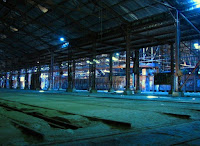


Unfortunately, within minutes, we were playing a high-adrenaline cat-and-mouse game with the on-site security who was with the shoot. The guard was unseen but we could always hear the shuffle of his feet just around the corner. This did not make for a pleasant exploration and we had left within ten minutes.

One of the few hasty photographs taken in the tunnel-kiln and dryer building.


In summary, what should have been a solid two hours of exploration through the site turned into a brief hurried foray in and straight out leaving us with only a paltry handful of pictures where others have hauled out dozens of spectacular breath-taking images (wahh!).

Another images through a door way into the kiln building. The security guard was just lurking off to the left when this was taken.


Another quick shot of a storage vessel in the Sand-Lime storage building originally where the slate-grinding equipment was installed.


One outside away from nasty model-photog event, Mr. Jack Morningwood and myself made like tourists and busied ourselves with a few uninteresting exterior shots.

Here, grasses take a tenacious root in a decaying rain gutter.


Here, an exterior shot of the Sand-Lime storage building providing us with the obligatory 'broken glass window' shot.


Presented here for the cartophiles who may be trolling these murky blogs is a map and legend for the industrial pad of the Don Valley Brickworks as extracted from the redevelopment Master Plan prepared for Evergreen by the Planning Alliance.


And now . . . A Short History of the Don Valley Brick Works
As extracted from the Master Plan mentioned above

In 1882, 25 year old William Taylor tested clay from digging fence post holes, and by 1889 he and his two brothers opened this brickyard that was to become pre-eminent in Canada. Their Don Valley Brick Works used rock and clay extracted from the quarry and water from Mud Creek to manufacture much of the bricks used to build Toronto. Buildings such as Casa Loma, Massey Hall, the Ontario Legislature, University of Toronto buildings such as Hart House and Convocation Hall and many homes throughout the city, were constructed using bricks from the Don Valley Brick Works.

Above - The Brickworks and quarry circa 1920's.

From its beginning in 1889 as a soft-mud brick plant using glacial clays, its managers continuously experimented and improved processing methods here until brick production stopped one hundred years later, in January 1989. The consequence was regular upgrading and replacement of equipment. Successful experiments in 1890 on the use of shale for making pressed brick brought about an immediate major plant expansion and the opening of the shale quarry. Different methods of handling the harder shale and the softer, less consolidated clays and sands, were implemented over the years. Among the various products of the Brick Works were: stiff-mud bricks, dry-press bricks, sand-lime bricks, decorative terracotta tiles and structural pieces. A wide variety was available, ten shades of red, seven shades of buff, plus olive gold, brown obsidian and mottled.
Above - The Brickworks and quarry circa 1890's.

It was the first, and for many years the only plant in Canada, to make glazed (enamelled) bricks and the first to install arch grinding machines to supply brick ground to order for flat, elliptical or circular arches. Their exhibit of pressed brick won the highest award at the World’s Columbian Exposition at Chicago in 1893, and they won two gold medals for their exhibit of brick and terracotta at the Toronto Industrial Fair of l894. This plant produced a wider variety of bricks and kiln fired clay products than any other brick plant in Ontario. Daily production increased from 44,000 bricks in 1891 to 120,000 by 1912. It is of interest to note that the while the buff coloured glacial clays produced yellow bricks, the blue shale produced red bricks. See picture of Brick Works Quarry in 1977 when still in operation.

Evergreen is transforming Toronto’s historic Don Valley Brick Works factory from an underused, deteriorating collection of buildings into a thriving environmentally-based community centre that engages visitors in diverse experiences connected to nature.